

Thailand Family Law Partners and the World Bank Women, Business and the Law Survey
Thailand Family Law Partners is proud to contribute legal insight to international research on women’s rights, family law, and access to justice in Thailand. One important example is our involvement in responding to legal and practical questions connected with the World Bank Women, Business and the Law survey.
The Women, Business and the Law project examines how laws and institutions affect women’s economic opportunities. In the Thai context, many of the relevant issues overlap with family law, civil status, property rights, marriage, divorce, children, nationality, mobility, and access to legal remedies. These are areas where the written law is important, but practical enforcement is equally important.
A law may appear equal on paper, but women may still face barriers if public authorities apply the rule inconsistently, require excessive documentation, delay recognition of rights, or fail to provide clear procedures. For this reason, the survey asks not only what the law says, but also how legal rights are upheld in practice.
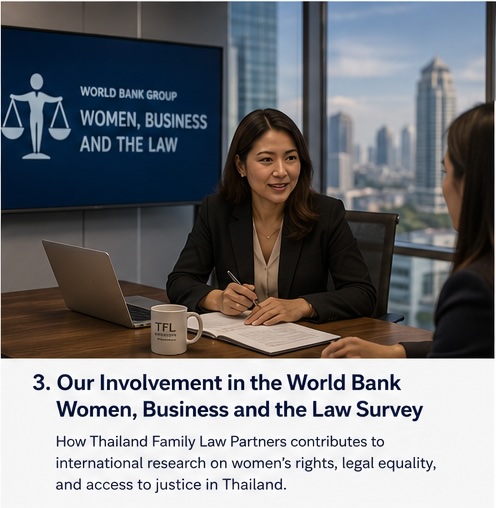
In Thailand, many formal legal rights are broadly equal between women and men. Adult women generally have independent legal capacity, can own property, enter contracts, apply for passports, travel domestically and internationally, file court claims, seek divorce, and act in relation to children where they have parental power. However, practical issues can still arise. These may include administrative discretion, inconsistent documentary requirements, delays in court, difficulties in cross-border family matters, and the need to prove status through official records.
TFL’s practical experience is useful because the firm regularly handles matters involving marriage and divorce, inheritance and probate, child custody, adoption, death certificates, and cross-border family law. The firm’s website identifies these as core service areas, including marriage and divorce, inheritance and probate, child custody, adoption, death in Thailand, and related family-law services.
Our perspective is grounded in actual client work. For example, a foreign spouse may need assistance registering a marriage or divorce in Thailand. A widow may need help accessing estate assets. A mother may need court orders concerning custody or travel. A family overseas may need a Thai death certificate or probate order. These cases show how law and administration interact in real life.
Participation in this type of survey also supports legal transparency. It helps international organizations understand whether formal equality is matched by practical access. It also helps identify areas where procedures can be improved, such as clearer public guidance, better online systems, faster court processing, more consistent district-office practice, and improved recognition of women’s rights in cross-border matters.
Thailand has made important progress in equality, including the legalization of same-sex marriage, which represents a major development in family rights and legal recognition. TFL’s News page also highlights Thailand’s marriage equality development as a landmark change for couples and families.
Contact TFL:
Thailand Family Law Partners remains committed to supporting equal access to family-law rights in Thailand and assisting clients who need practical help enforcing those rights. Contact us today at info@thailandfamilylaw.com or by phone, WhatsApp, or Line at +66 855 393 675
