• bank

    Marriage & Divorce

    With over 30 years of experience assisting with matters of marriage & divorce in Thailand, TFL can guide you through these important events. More

  • billing

    Inheritance & Probate

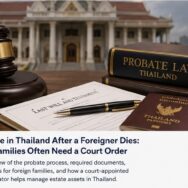
    TFL can help you become executor of the estate of your family member who passed away in Thailand and gain access to their property. More

  • customers

    Child Custody

    TFL can ensure you get proper custody of your child and protect your children from being abducted or taken against their will. More

  • my-account

    Death in Thailand

    If your family member has died in Thailand, contact TFL to act as funeral director, transport the body, and handle all death certificates. More

Thailand Family Law Partners (TFL)

The skilled lawyers and solicitors at TFL provide a variety of professional legal services to both foreign and Thai clientele in Bangkok, Pattaya, Phuket, Chiang Mai, Koh Samui, Hua Hin, Udon Thani, Chonburi, Samut Prakarn, Nonthaburi, Surat Thani, and the rest of Thailand.

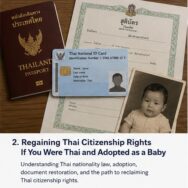
Regaining Thai Citizenship Rights If You Were Thai and Adopted as a Baby

Some people were born in Thailand, adopted as babies or young children, and raised overseas. Years later, they may want to know whether they are still Thai, whether they can obtain a Thai ID card or passport, or whether they need to “regain” Thai citizenship.

The answer depends on the person’s original legal status and what happened after adoption. Being adopted abroad does not automatically answer the question. The key issues are usually: Was the person born in Thailand? Was one parent Thai? Was Thai nationality ever formally renounced, revoked, or lost? Is there a Thai birth certificate? Was the person ever registered in a Thai house registration book? Were any Thai ID documents previously issued?

Thai nationality law is based partly on descent. A person born to a Thai mother or Thai father may acquire Thai nationality by birth, subject to the applicable law and facts. The Thai Nationality Act also contains provisions on loss and recovery of Thai nationality. For example, Section 22 refers to loss of Thai nationality where a Thai national has been naturalized as an alien, has renounced Thai nationality, or has had Thai nationality revoked. Section 23 deals with recovery of Thai nationality in certain circumstances.  

For an adopted child, the practical question is often not “Can I become Thai again?” but rather “Was I ever legally removed from Thai nationality, or do I simply need to prove and restore my Thai documentation?” In some cases, the person may still be Thai under the law but lacks current documents. In other cases, the person may need to apply for recovery or recognition of Thai nationality through the appropriate Thai authority.

Read more

Thailand Family Law Partners and the World Bank Women, Business and the Law Survey

Thailand Family Law Partners is proud to contribute legal insight to international research on women’s rights, family law, and access to justice in Thailand. One important example is our involvement in responding to legal and practical questions connected with the World Bank Women, Business and the Law survey.

The Women, Business and the Law project examines how laws and institutions affect women’s economic opportunities. In the Thai context, many of the relevant issues overlap with family law, civil status, property rights, marriage, divorce, children, nationality, mobility, and access to legal remedies. These are areas where the written law is important, but practical enforcement is equally important.

A law may appear equal on paper, but women may still face barriers if public authorities apply the rule inconsistently, require excessive documentation, delay recognition of rights, or fail to provide clear procedures. For this reason, the survey asks not only what the law says, but also how legal rights are upheld in practice.

Read more

Same-Sex Marriage in Thailand: What Foreign Couples Should Know

Thailand has become one of the most important jurisdictions in Asia for marriage equality. Thailand’s marriage equality law allows same-sex couples to legally marry, and this development has attracted attention from couples around the world. TFL’s News page notes that Thailand’s marriage equality law allows same-sex couples to legally marry from January 22, 2025, and describes the reform as a major step for equal rights in Thailand.  

For foreign same-sex couples, Thailand may be an attractive place to marry, but the process still requires preparation. A couple cannot simply arrive in Thailand and register the marriage immediately without the correct documents. Foreigners usually need documents from their respective embassies confirming their legal capacity to marry. These documents must usually be translated into Thai and submitted through the required Thai administrative process before the marriage can be registered at a district office.

The exact requirements depend on nationality. A Spanish citizen, Filipino citizen, American citizen, British citizen, German citizen, or other foreign national may each face different embassy requirements. Some embassies issue an affidavit of freedom to marry. Others issue a certificate of no impediment or similar document. The wording, appointment system, processing time, and supporting documents can vary significantly.

Read more